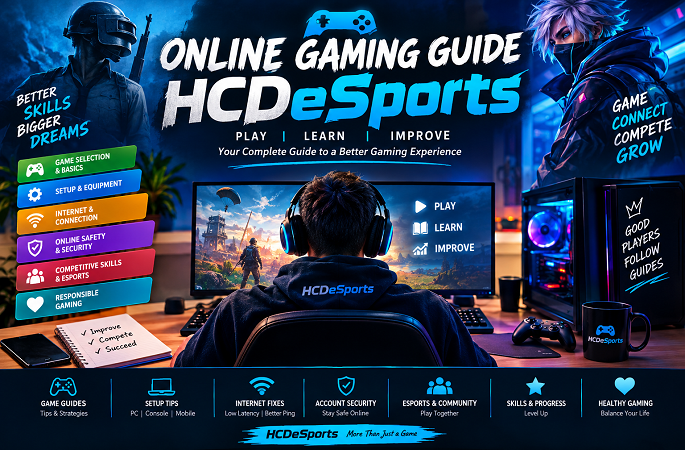

The world of online gaming continues to grow as players look for better ways to discover games, improve their skills, understand competitive gameplay, and stay updated with the latest developments. An online gaming guide hcdesports can help players organise their gaming experience by covering important topics such as game selection, controls, strategies, performance optimisation, online safety, and competitive gaming.
Whether you are completely new to online gaming or have already spent hours playing your favourite titles, having a structured guide can make the experience easier and more enjoyable. Instead of learning everything through trial and error, players can use reliable gaming information to understand common mechanics, develop better habits, and make informed decisions about their gaming setup.
This guide explores the major areas that modern gamers should understand. From choosing the right game and improving gameplay to managing performance and maintaining healthy gaming habits, the following sections provide practical information for beginners and experienced players alike.
Also Read: Etruesports ETSJavaApp Guide
What Is an Online Gaming Guide HCDesports?
The phrase online gaming guide hcdesports can be used to describe a broad resource focused on online gaming information, strategies, tips, and player education. A useful gaming guide should not focus only on one game. Instead, it can provide general knowledge that applies across different genres and platforms.
Online games can include competitive shooters, sports games, strategy titles, role-playing games, multiplayer adventures, racing games, and casual experiences. Each genre requires different skills. For example, competitive shooters often emphasise reaction time and positioning, while strategy games require planning, resource management, and decision-making.
A good guide helps players understand these differences. It can also explain how to select suitable games, configure controls, improve performance, and communicate effectively with teammates.
Why Online Gaming Guides Are Useful
Many players start a new game without understanding its basic systems. Although experimentation is an important part of gaming, structured information can shorten the learning process.
An online gaming guide can help players:
- Understand basic gameplay mechanics
- Learn common strategies
- Improve controls and settings
- Choose appropriate hardware
- Reduce unnecessary performance problems
- Develop better teamwork
- Understand competitive gaming
- Protect gaming accounts
- Manage gaming time effectively
For beginners, these points can create a strong foundation. Experienced players can also use guides to identify weaknesses and experiment with new strategies.
Choosing the Right Online Game
One of the first steps in improving your gaming experience is selecting games that match your interests and available equipment. Not every game is suitable for every player.
Before downloading or purchasing a game, consider its genre, system requirements, multiplayer features, community, gameplay style, and learning curve.
For example, players who enjoy quick matches may prefer competitive action games. Someone who likes long-term planning may enjoy strategy games. Players interested in exploration might prefer open-world or role-playing games.
Hardware is also important. A game may require a powerful computer or modern console to operate smoothly. Checking minimum and recommended requirements before installation can prevent unnecessary problems.
Understanding Game Controls
Controls are one of the most important parts of online gaming. Even a player with excellent strategic knowledge can struggle if the controls are uncomfortable or unfamiliar.
PC gamers should become comfortable with keyboard and mouse settings, while console players need to understand controller layouts. Mobile gamers should learn touch controls and customise them where appropriate.
Important control considerations include:
- Sensitivity
- Key or button mapping
- Camera movement
- Aim settings
- Movement controls
- Interface placement
- Audio controls
Players should avoid changing settings constantly. Instead, test a configuration for several sessions and make gradual adjustments based on actual gameplay.
Improving Gaming Performance
Performance can significantly affect an online gaming experience. Frame rate, latency, graphics settings, storage speed, and background applications can all influence gameplay.
Players using computers should make sure their systems meet the game’s requirements. Closing unnecessary applications can free system resources. Keeping drivers and supported software updated may also help maintain compatibility.
Graphics settings can be adjusted according to hardware capability. Higher graphics quality may produce better visuals, but lower settings can sometimes provide smoother gameplay on less powerful devices.
A practical approach is to prioritise stable performance rather than maximum graphical quality.
Understanding Internet Connection and Latency
Online multiplayer games depend heavily on network communication. A player’s actions need to travel between their device and the game server, while information from other players must return to their device.
Latency, commonly measured in milliseconds, represents communication delay. Lower latency generally provides a more responsive online experience.
Players experiencing connection problems can check several factors:
- Router placement
- Wi-Fi signal strength
- Background downloads
- Network congestion
- Device connectivity
- Internet service stability
Whenever possible, a wired connection can provide a more consistent connection than unstable wireless connectivity. However, Wi-Fi can work well when the signal is strong and the network is properly configured.
Developing Better Gaming Skills
Improvement in online gaming usually comes from consistent practice rather than simply playing for long hours.
Players should identify specific areas that need improvement. For example, a competitive shooter player might work on aiming and positioning, while a strategy player could focus on resource management and decision-making.
A useful practice routine might include:
- Learning the basic mechanics
- Practising one skill at a time
- Reviewing mistakes
- Watching educational gameplay
- Experimenting with different strategies
- Practising communication
- Tracking progress
The goal should be deliberate practice. Playing repeatedly without thinking about mistakes may not produce the same improvement as focused practice.
Teamwork and Communication
Many online games involve teams, making communication an important skill. Good teamwork can help players coordinate objectives, share information, and respond to changing situations.
Effective communication should be short, clear, and relevant. Players should communicate useful information rather than overwhelming teammates with unnecessary messages.
Respectful communication also contributes to a healthier gaming environment. Arguments, harassment, and excessive negative behaviour can make multiplayer games unpleasant for everyone.
Players should remember that every teammate is learning and improving at a different pace.
Competitive Online Gaming
Competitive gaming has developed into a major part of the modern gaming ecosystem. Players can participate in ranked modes, tournaments, community competitions, and organized esports events.
Competitive gaming generally requires more than basic knowledge of a title. Players need mechanical skill, strategic understanding, communication, consistency, and the ability to adapt.
A competitive player can benefit from reviewing previous matches. Looking at mistakes objectively may reveal recurring problems such as poor positioning, unnecessary engagements, inefficient resource use, or weak communication.
The competitive environment can be demanding, so maintaining realistic goals is important. Improvement should be measured over time rather than based on the result of a single match.
Online Gaming Safety
Gaming accounts can contain valuable information, purchases, achievements, and personal data. Protecting these accounts should therefore be part of every player’s routine.
Players should use strong and unique passwords whenever possible. Two-factor authentication should be enabled when supported by the gaming service.
Players should also be cautious about suspicious links, fake giveaways, unofficial downloads, and messages requesting account credentials.
Never provide your password or security codes to strangers. Official gaming companies generally provide dedicated account-security and support systems rather than requiring users to share passwords through random messages.
Avoiding Unsafe Downloads
The internet contains many unofficial gaming websites offering modified applications, cheats, unlockers, or supposedly free versions of paid content. These downloads may carry security risks.
Players should obtain games and updates through legitimate stores or official sources whenever possible.
Before installing unfamiliar software, consider:
- Who published it?
- Is the source trustworthy?
- Does the file match the expected software?
- Is the website using suspicious download buttons?
- Are security warnings appearing?
- Is the software requesting unnecessary permissions?
A cautious approach can reduce the risk of malware, account theft, and unwanted software.
Building a Comfortable Gaming Setup
A gaming setup does not have to be expensive to be effective. Comfort and reliability are often more important than having the most expensive equipment.
A basic setup may include a suitable display, a comfortable input device, a stable internet connection, headphones or speakers, and an appropriate chair or desk.
Players should pay attention to posture and screen position. Taking regular breaks can also reduce discomfort during longer gaming sessions.
For competitive players, equipment upgrades should be based on actual needs rather than marketing claims.
Mobile Online Gaming
Mobile gaming has become an important part of the online gaming industry. Smartphones can provide access to multiplayer games without requiring a dedicated gaming computer or console.
Mobile players should consider device storage, battery health, network stability, display responsiveness, and temperature.
Keeping unnecessary applications closed can sometimes improve available resources. Players should also avoid covering device ventilation areas during demanding gaming sessions.
Because mobile games can involve purchases, parents and younger players should understand account and payment settings.
Gaming Settings Guide: Online gaming guide hcdesports
Different games provide different configuration options, but several categories are commonly important.
| Setting | Purpose | General Recommendation |
|---|---|---|
| Graphics Quality | Controls visual detail | Match it to hardware. |
| Resolution | Determines image sharpness | Use a stable supported resolution |
| Frame Rate | Controls visual smoothness | Prioritise consistency. |
| Sensitivity | Controls movement or aiming | Choose a comfortable value |
| Audio | Controls sound effects and voice | Keep important sounds clear. |
| Network Region | Connects to available servers | Select an appropriate region. |
| Controls | Determines input layout | Customise for comfort. |
| Display Mode | Controls window behaviour | Choose according to your setup. |
Managing Gaming Time: Online gaming guide hcdesports
Gaming can be an enjoyable hobby, but balance is important. Long uninterrupted sessions can affect sleep, physical activity, study, work, and social responsibilities.
Players can create a simple gaming schedule that leaves enough time for other activities. Regular breaks can also help maintain concentration.
A balanced approach does not mean avoiding gaming. Instead, it means making gaming part of a broader daily routine.
How to Improve Faster
Players looking for consistent improvement can follow a simple process.
Step 1: Learn the Basics
Understand the rules, controls, objectives, maps, characters, weapons, vehicles, or other core mechanics relevant to the game.
Step 2: Choose One Skill
Avoid trying to improve everything simultaneously. Select one area such as aiming, movement, strategy, or communication.
Step 3: Practice Consistently
Short, focused practice sessions can be more useful than unfocused hours of gameplay.
Step 4: Review Mistakes
Ask what happened, why it happened, and what could be changed next time.
Step 5: Experiment
Try alternative strategies and determine which approaches fit your playstyle.
Step 6: Track Progress
Keep simple notes about recurring mistakes and improvements. Over time, this can make progress easier to recognise.
Common Mistakes New Online Gamers Make
Beginners often make similar mistakes. One common problem is changing settings too frequently. Players may copy configurations from professional gamers without understanding why those settings work for them.
Another mistake is focusing entirely on individual performance in team-based games. Team objectives often matter more than individual statistics.
Ignoring internet stability is another issue. Players sometimes blame their own gameplay when connection problems are actually affecting responsiveness.
Finally, many beginners expect immediate improvement. Gaming skills develop through repetition, feedback, and experience.
Online Gaming Guide HCDesports: Quick Reference
| Topic | Key Point |
|---|---|
| Game Selection | Choose games that match your interests and hardware. |
| Controls | Customise them for comfort. |
| Performance | Prioritise stable gameplay. |
| Internet | Reduce avoidable connection problems. |
| Practice | Focus on specific skills. |
| Teamwork | Communicate clearly. |
| Security | Protect accounts and personal information. |
| Downloads | Use trusted sources. |
| Hardware | Upgrade based on actual needs. |
| Health | Take regular breaks. |
| Competition | Focus on long-term improvement. |
The Future of Online Gaming: Online gaming guide hcdesports
Online gaming continues to develop as technology improves. Faster networks, cloud services, improved graphics hardware, cross-platform features, artificial intelligence, and new social systems are influencing how people play.
Future gaming experiences may offer more interconnected communities and increasingly sophisticated multiplayer environments. At the same time, players will continue to need fundamental skills such as communication, security awareness, adaptability, and responsible gaming habits.
The most useful gaming knowledge is therefore not limited to a single title. Understanding general principles can help players adapt when they move from one game to another.
(FAQs): About the online gaming guide hcdesports
What is an online gaming guide hcdesports?
An online gaming guide hcdesports can refer to a gaming-focused resource covering gameplay strategies, settings, performance, online safety, competitive gaming, and other useful information for players.
Is this guide suitable for beginners?
Yes. The information covers fundamental topics such as game selection, controls, performance, networking, security, and practice techniques that beginners can use.
How can I improve my online gaming skills?
Focus on specific skills, practise consistently, review mistakes, learn from reliable educational content, and experiment with different strategies.
Does better gaming hardware automatically make someone a better player?
No. Better hardware can improve performance or comfort, but gameplay skill depends on practice, decision-making, game knowledge, and other factors.
How can I reduce online gaming lag?
Check your network connection, reduce unnecessary network activity, use a stable connection, and select an appropriate game-server region when the game provides that option.
Should I copy professional gamers’ settings?
Professional settings can provide ideas, but they should not be treated as universal solutions. Test different configurations and select settings that feel comfortable and perform reliably on your own equipment.
Is online gaming safe?
Online gaming can be safe when players use trusted platforms, protect account credentials, avoid suspicious downloads and links, and use appropriate privacy and security settings.
How long should a gaming session last?
There is no single session length that works for everyone. Players should take regular breaks and ensure gaming does not interfere with sleep, responsibilities, physical activity, or other important parts of daily life.
What is the most important gaming skill?
There is no single skill that applies equally to every game. Depending on the title, important abilities can include game knowledge, reaction time, strategy, communication, positioning, resource management, and adaptability.
Can an online gaming guide help competitive players?
Yes. Guides can provide ideas about settings, practice routines, strategy concepts, communication, and performance optimisation. Competitive players should still adapt general recommendations to their specific game and role.
Conclusion: Online gaming guide hcdesports
A well-structured online gaming guide hcdesports can help players approach online gaming more effectively. From selecting suitable games and configuring controls to improving skills, protecting accounts, and maintaining healthy gaming habits, each part of the gaming experience contributes to overall enjoyment.
The most effective approach is to learn gradually, practise with purpose, and adapt recommendations to individual needs. Players should focus on stable performance, respectful communication, account security, and continuous improvement rather than expecting instant results.
Whether you are discovering online gaming for the first time or working to improve your competitive performance, understanding the fundamentals provides a useful foundation. With consistent practice and responsible gaming habits, players can build a more organized, enjoyable, and sustainable gaming experience.



Pingback: Gaming News EteSportech from eTrueSports | Latest Updates