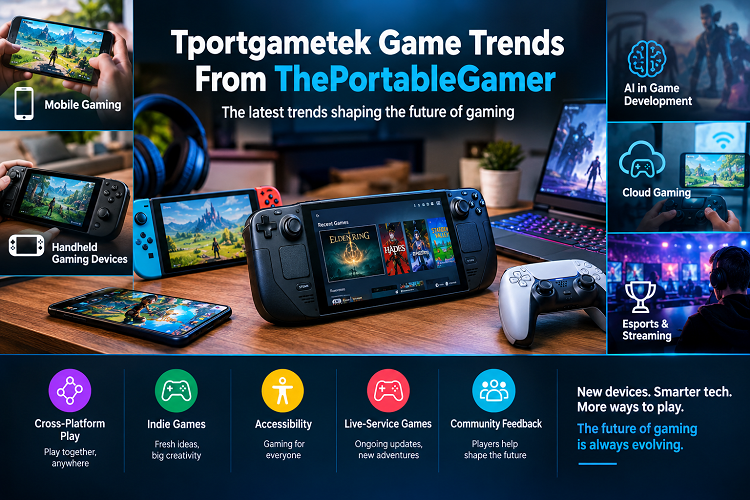

The gaming industry is changing quickly. Mobile devices are more powerful, handheld consoles are becoming increasingly popular, and cloud technology is making it easier to play games without expensive hardware. At the same time, artificial intelligence, cross-platform features, and online communities are influencing how developers create games and how players experience them. For gamers who want to keep up with these developments, Tportgametek game trends from ThePortableGamer offers a useful starting point for exploring the technologies, devices, and ideas shaping modern gaming.
Rather than focusing on a single console or genre, this topic brings together several important areas of the gaming landscape. These include mobile gaming, portable hardware, cloud streaming, esports, indie development, accessibility, and the growing role of player feedback.
It is worth clarifying that Tportgametek is not a universally recognised technical term or an established category within the gaming industry. Here, it refers to the gaming trends and technology themes associated with the topic. Readers should verify specific product claims, release information, and platform features through official sources.
Also Read: Latest News PlayMyWorld: Updates & Gaming Trends 2026
Tportgametek game trends can be understood as developments in gaming technology, player behaviour, hardware, and game design that influence the industry. These trends help explain why gaming looks different today than it did even a few years ago.
Consider how people play. Some prefer competitive PC gaming, while others spend their time on smartphones, handheld devices, or consoles connected to a television. Cloud gaming offers another option, allowing supported titles to stream to compatible devices rather than relying entirely on local hardware.
The business behind gaming is changing, too. Developers increasingly support games after launch, creators share gameplay with global audiences, and online communities influence which features players want to see next.
For readers following The Portable Gamer-related gaming content: understanding these developments provides a clearer picture of where the industry is heading. The key is to separate meaningful changes from short-lived hype.
1. Mobile Gaming Continues to Reach More Players: Tportgametek game trends from ThePortableGamer
Mobile gaming has become a central part of the entertainment industry. Smartphones are widely available, games cover nearly every genre, and players can enjoy short sessions without investing in a dedicated gaming system.
The appeal goes beyond convenience. Modern phones can handle visually sophisticated games, online multiplayer matches, strategy titles, racing games, and competitive experiences. Better processors, improved displays, and faster wireless connections have also expanded what developers can build for mobile platforms.
Free-to-play games have helped attract new audiences. Many offer free access to the core experience while generating revenue through optional purchases, cosmetic items, subscriptions, or other in-game features. These models can make games easier to try, although players should review spending options carefully.
Mobile gaming does have limitations. Battery life, device temperature, touchscreen controls, storage capacity, and inconsistent network performance can affect the experience. Some games also rely heavily on in-app purchases.
For players, the best approach is to choose games that suit their devices, budgets, and preferred play styles. For developers, mobile remains an important platform for reaching audiences who may never purchase a traditional console.
2. Handheld Gaming Devices Are Gaining Momentum
Portable gaming hardware offers a middle ground between a smartphone and a full desktop gaming setup. Devices such as the Nintendo Switch, Valve’s Steam Deck, and the ASUS ROG Ally give players different ways to enjoy games away from a traditional desk.
These products do not all work the same way. The Nintendo Switch emphasises a console-style experience with handheld and television play. The Steam Deck provides access to a substantial portion of the PC gaming ecosystem, subject to game compatibility. The ASUS ROG Ally family runs Windows and supports a range of PC gaming services.
Their growing appeal reflects a simple preference: players want more freedom over where they play.
A handheld device can make a long trip, a lunch break, or a quiet evening more entertaining. It can also reduce the need to stay in one room to enjoy a favourite game. However, portable hardware comes with trade-offs. Battery life, weight, screen size, heat, storage, and performance vary by model.
Price matters as well. A premium handheld may cost considerably more than a basic gaming console or entry-level gaming accessory. Buyers should compare the full cost, including storage upgrades, protective cases, subscriptions, and compatible games.
Before purchasing, check the manufacturer’s specifications and the compatibility of the games you want to play. A device’s advertised capabilities do not guarantee that every game will run equally well.
3. Cloud Gaming Is Expanding Access: Tportgametek game trends from ThePortableGamer
Cloud gaming changes where a game runs. Instead of depending entirely on a player’s local hardware, a supported game runs on remote servers and streams its output over the internet.
Services such as NVIDIA GeForce NOW and Xbox Cloud Gaming illustrate different approaches to this model. Availability, game catalogues, subscription requirements, supported devices, and regional access vary by service and can change over time.
The main attraction is flexibility. Players may be able to stream supported games on a compatible computer, tablet, phone, or television without buying a high-end gaming PC. Depending on the service, cloud gaming can also reduce the need to download large game files or install frequent updates locally.
However, cloud gaming is not a universal replacement for local hardware. A reliable internet connection is essential, and network congestion can lead to lag, lower image quality, or interruptions. Competitive games are particularly sensitive to latency.
Subscription costs also deserve attention. Some services require paid memberships, and access to a particular game may depend on licensing or account ownership rules.
Cloud gaming is most useful for players whose internet connections and preferred games are well supported. Before subscribing, check regional availability, connection requirements, supported devices, and the current game catalogue.
4. Artificial Intelligence Is Influencing Game Development
Artificial intelligence is becoming a more visible part of game development. Studios use a range of AI techniques to support testing, animation, procedural content, player behaviour, and other production tasks.
In some games, AI controls non-player characters, helping them react to the environment or respond to player actions. Developers can also use automated systems to identify bugs, test game scenarios, or assist with repetitive production work.
Generative AI has introduced additional possibilities. Depending on how it is implemented, it may help teams explore dialogue ideas, create prototypes, or speed up certain content workflows. These uses remain an evolving area, and their value depends on the quality of the tools and the oversight provided by developers.
There are important concerns, too. Poorly implemented AI can produce repetitive interactions or undermine the creative quality of a game. The use of generated content can raise questions about consent, copyright, training data, and the rights of artists and performers. Players may also want transparency about how AI is used.
AI should not automatically be treated as a sign that a game is better. What matters is whether the technology improves the experience, supports creative work responsibly, and delivers something players genuinely value.
5. Cross-Platform Play Is Bringing Communities Together
Cross-platform play allows people using different supported gaming systems to play together. Depending on the title, that may mean joining a match across PC, console, and mobile devices.
This feature can make multiplayer games more accessible to friends who own different hardware. It may also help maintain healthier matchmaking pools by bringing more players into a shared environment.
Cross-progression is related but distinct. It allows certain game progress, purchases, or account information to carry between supported platforms. A title may offer cross-platform play without cross-progression, so players should not assume the two features are interchangeable.
Developers face several challenges when implementing these systems. They must manage account linking, platform policies, matchmaking, security, and technical differences between devices. Competitive games may also need input-based matchmaking or other balancing measures to create fairer matches.
For players, cross-platform features are worth checking before buying a game with friends. Confirm which systems are supported, whether separate accounts are required, and whether progress transfers between platforms.
As more games adopt flexible multiplayer systems, platform choice becomes less of a barrier to shared play.
6. Esports and Game Streaming Continue to Shape Gaming Culture
Competitive gaming has developed into a broad entertainment ecosystem. Esports events bring players and fans together through tournaments, online broadcasts, live venues, and community discussion.
Streaming platforms have also changed how people discover games. Viewers can watch experienced players, learn strategies, follow competitive teams, or simply enjoy a creator’s personality. For some audiences, watching gaming content is as important as playing.
The relationship works both ways. A popular streamer can draw attention to a lesser-known title, while a major tournament can introduce new audiences to a competitive game. Developers may use creator partnerships and community events to maintain interest in their releases.
However, visibility does not guarantee long-term success. A game needs a compelling experience, reliable updates, a healthy community, and a reason for players to return. Streaming trends can also shift quickly.
Anyone interested in esports should look beyond headline prize pools. Team management, training, sponsorships, broadcast production, coaching, and community operations all contribute to the wider industry.
For aspiring players, consistent practice and good communication matter more than chasing instant popularity. For viewers, reputable broadcasts and official tournament channels are useful starting points for following events.
7. Indie Games Are Bringing Fresh Ideas to the Market
Independent developers play an important role in keeping gaming creative. Without the same budgets or organizational structures as major publishers, smaller teams can sometimes experiment with unusual mechanics, distinctive visual styles, and personal storytelling.
Indie games span nearly every genre. Some focus on short, tightly designed experiences, while others offer expansive role-playing systems, survival mechanics, puzzle challenges, or unusual combinations of familiar ideas.
Digital distribution has helped these developers reach players worldwide. Platforms such as Steam give many independent studios a route to publish and promote their work, although visibility remains a challenge in crowded marketplaces.
Smaller budgets do not automatically mean lower quality. Some independent games deliver polished mechanics and memorable stories, while others may launch with bugs or limited content. Players should assess each release on its own merits.
Reviews, gameplay footage, developer updates, and refund policies can help buyers make informed decisions. It is also worth remembering that early-access titles are still in development and may change substantially before a full release.
For gamers looking for something beyond the biggest franchises, indie releases can offer some of the most interesting experiences available.
8. Accessibility Is Becoming an Essential Design Consideration
Accessibility helps more people enjoy games, including players with visual, hearing, motor, cognitive, or other access needs. Rather than being an optional extra, thoughtful accessibility design can make a game easier to use for a broader audience.
Useful features include adjustable subtitles, high-contrast interfaces, colorblind-friendly settings, remappable controls, customizable difficulty, aim assistance, and alternatives to rapid button presses. The most appropriate options depend on the game and the needs of individual players.
Accessibility can benefit people who do not identify as disabled, too. Clear subtitles help in noisy environments, adjustable text can reduce eye strain, and flexible controls can make long sessions more comfortable.
Good implementation requires more than adding a few settings at the end of development. Testing with players who have different needs can reveal problems that a development team might otherwise overlook.
When evaluating a game, check its accessibility options before purchasing, especially if a particular feature is essential. The ESRB’s rating information can help families understand age suitability and content descriptors, but it is not a substitute for reviewing a game’s accessibility features.
A more accessible industry gives more people the opportunity to participate in gaming on their own terms.
9. Live-Service Games Are Changing How Titles Evolve
Traditional games often delivered most of their content at launch, followed by occasional updates or expansions. Live-service games take a different approach, adding features, events, balance changes, and other content over time.
This model can keep a game feeling fresh. Seasonal events may introduce new challenges, while updates can address technical problems or adjust competitive balance. A committed community can also give developers useful feedback about what works and what needs improvement.
The approach has drawbacks. Some games depend on recurring purchases, battle passes, or time-limited rewards. Players may feel pressured to log in frequently to avoid missing content. Frequent updates can also consume storage space or introduce new bugs.
Long-term support is not guaranteed. A game’s future depends on the publisher’s plans, player activity, operating costs, and business priorities. Online-only titles may eventually become inaccessible if their servers shut down.
Before investing heavily in a live-service game, consider its monetization model, update history, community response, and dependence on online servers. Players should also decide how much time and money they want to spend.
A healthy live-service game respects players’ time while giving them meaningful reasons to return.
10. Community Feedback Is Influencing Game Updates
Online communities have become an important source of information for game developers. Players share bug reports, discuss balance changes, post gameplay clips, and suggest improvements through forums, social platforms, review pages, and official feedback channels.
Developers can use this information to identify recurring problems and understand how a game performs outside internal testing. Community feedback has helped draw attention to performance issues, confusing interfaces, accessibility gaps, and features that players want improved.
Still, online reactions are not always representative of the entire audience. A small group of highly active users may dominate a discussion, and criticism can sometimes be driven by incomplete information or unrealistic expectations.
Responsible studios look for patterns rather than responding to every complaint. They combine player feedback with technical data, usability testing, development constraints, and their long-term design goals.
Players can make their feedback more useful by providing clear reproduction steps, system specifications, screenshots, or short recordings when reporting a technical problem. Respectful, specific reports are generally easier for developers to act on than vague complaints.
Community participation works best when both sides understand its limits. Players can influence a game’s direction, but not every suggestion will be practical or appropriate.
Tportgametek Gaming Trends at a Glance: Tportgametek game trends from ThePortableGamer
The following table summarizes the main trends discussed above and explains why each matters to players.
| Gaming trend | What it means | Potential benefit | Main consideration |
|---|---|---|---|
| Mobile gaming | Games designed for smartphones and tablets | Convenient access and broad choice | Battery, controls, and in-app spending |
| Handheld devices | Portable consoles and PC gaming systems | Play away from a desk or television | Price, weight, battery life, and compatibility |
| Cloud gaming | Games streamed from remote servers | Access without powerful local hardware | Internet quality, latency, and subscriptions |
| Artificial intelligence | AI tools used in development and gameplay | New interactions and more efficient workflows | Quality, transparency, and ethical concerns |
| Cross-platform play | Multiplayer across supported systems | Easier play with friends | Compatibility and account requirements |
| Esports and streaming | Competitive gaming and live content | Community, learning, and entertainment | Rapidly changing trends and career uncertainty |
| Indie games | Games created by independent studios | Creative ideas and diverse experiences | Variable quality and limited visibility |
| Accessibility | Features that support different player needs | More inclusive gaming | Options vary from game to game |
| Live-service games | Titles updated after launch | Ongoing events and new content | Recurring costs and server dependence |
| Community feedback | Player input used to guide improvements | Better-informed updates | Online reactions may not reflect everyone |
What Gaming Statistics Tell Us About the Industry: Tportgametek game trends from ThePortableGamer
Gaming is no longer a niche activity limited to a particular age group or type of device. Research from the Entertainment Software Association (ESA) offers a broader view of how widely games are played in the United States.
The ESA’s 2026 reporting states that 212.3 million Americans play video games weekly, with 67% of people ages 5–90 playing for at least an hour each week. These figures illustrate the scale of gaming as a mainstream form of entertainment.
Readers should consult the ESA’s original report for the exact survey question, methodology, and population covered by those figures. Statistics can be interpreted incorrectly when the survey scope or definitions are omitted.
The wider takeaway is that gaming serves many purposes. People play to relax, spend time with friends, compete, explore stories, or learn new skills. That diversity helps explain why the industry supports so many devices, genres, business models, and communities.
Benefits and Challenges of Today’s Gaming Trends: Tportgametek game trends from ThePortableGamer
The changes shaping gaming create opportunities, but they also bring trade-offs. Understanding both sides helps players decide which developments genuinely improve their experience.
Key benefits
- More ways to play: Mobile devices, handheld systems, PCs, and consoles provide different options for different budgets and lifestyles.
- Greater flexibility: Cloud gaming and portable hardware can reduce dependence on a single gaming location.
- Stronger social connections: Cross-platform play and online communities help friends connect across devices and locations.
- More creative choices: Independent studios bring new ideas to a market often dominated by established franchises.
- Better access: Accessibility features can make games more comfortable and usable for a wider range of people.
- Ongoing improvements: Updates and community feedback can help developers refine games after release.
Challenges to consider
- Rising costs: Hardware, subscriptions, downloadable content, and in-game purchases can add up.
- Internet dependence: Online multiplayer and cloud streaming may be unreliable on weak connections.
- Privacy and security: Gaming accounts can contain personal information, purchase records, and social connections.
- Time pressure: Some live-service systems encourage frequent play through limited-time rewards.
- Compatibility issues: Not every game supports every device, control method, or cross-platform feature.
- Uncertain longevity: Online-only games can become unavailable when publishers discontinue server support.
A good gaming setup is not necessarily the most expensive one. The right choice depends on what you play, who you play with, and how much you want to spend.
How to Choose the Right Gaming Technology for You: Tportgametek game trends from ThePortableGamer
Following gaming trends is useful, but buying every new device or subscribing to every service is rarely necessary. A more practical approach starts with your needs.
Set a realistic budget
Include more than the purchase price. Consider accessories, games, subscriptions, storage, internet costs, and potential repairs. If you are buying a handheld or console, compare the total cost of ownership rather than focusing on one headline price.
Choose games before choosing hardware
Make a list of the games you actually want to play. Check their platform availability, performance requirements, and compatibility before deciding which device to buy.
Think about where you play
A desktop PC may suit someone who wants high performance and customization. A handheld may be better for travel, while a console may offer a straightforward living-room experience. Mobile gaming can be enough for players who prefer casual sessions.
Check online requirements
If you play competitive multiplayer games or plan to use cloud streaming, internet quality matters. Look into connection requirements, data limits, supported regions, and the service’s current policies.
Read recent reviews
Specifications tell only part of the story. Independent testing and recent user feedback can reveal battery problems, software issues, poor performance, or features that do not work as expected.
Protect your accounts
Use strong, unique passwords and enable multifactor authentication when available. Be cautious with unofficial downloads, suspicious links, and offers that appear too good to be true. Review parental controls and spending settings when children use gaming devices.
(FAQs): About Tportgametek game trends from ThePortableGamer
1. What does Tportgametek game trends from ThePortableGamer mean?
The phrase refers to gaming developments associated with the topic, including mobile gaming, handheld devices, cloud streaming, AI, esports, and cross-platform play. Tportgametek is not a universally established technical term, so readers should confirm any specific claims through reliable sources.
2. What are the biggest gaming trends today?
Important areas include mobile gaming, portable gaming hardware, cloud gaming, AI-assisted development, cross-platform multiplayer, esports, indie games, accessibility, and ongoing game updates. Their importance varies by platform, genre, and audience.
3. Are handheld gaming devices worth buying?
They can be a good choice for people who value portability. The best option depends on game compatibility, price, battery life, weight, performance, and whether you prefer a console-style or PC-based experience.
4. Is cloud gaming better than a gaming PC or console?
Not for everyone. Cloud gaming can reduce the need for powerful local hardware, but it relies on a suitable internet connection and a supported game catalog. A PC or console may offer more reliable local performance and greater independence from streaming conditions.
5. How is AI changing video games?
AI can support non-player character behavior, testing, procedural systems, and certain development tasks. Generative AI is also being explored for content workflows. Results vary, and ethical questions around transparency, copyright, and creative work remain important.
6. What is the difference between cross-platform play and cross-progression?
Cross-platform play lets users on different supported systems play together. Cross-progression allows eligible game progress or account information to carry between supported platforms. A game may provide one feature without offering the other.
7. Why are indie games important?
Independent developers often experiment with distinctive mechanics, art styles, and storytelling. They broaden the range of available games and can introduce ideas that larger studios later explore.
8. What should players know about live-service games?
Live-service games receive ongoing updates and may include seasonal content, subscriptions, or optional purchases. Players should understand the monetization model, time commitment, and possibility that online services could eventually end.
9. How can I keep up with gaming trends without spending too much?
Follow reputable gaming publications, official developer announcements, and independent reviews. Compare devices before buying, use free demos where available, and focus on games and services that match your interests rather than purchasing every new release.
10. How can a gaming website write a trustworthy trend article?
A reliable article should verify claims, distinguish facts from predictions, link to authoritative sources, and explain the limitations of its evidence. Original testing, transparent authorship, meaningful comparisons, and clear writing help readers assess the information for themselves.
Conclusion: Tportgametek game trends from ThePortableGamer
Tportgametek game trends from ThePortableGamer brings together several developments that are changing the way people play, buy, develop, and discuss video games. Mobile gaming continues to provide convenient access, handheld devices offer greater freedom, and cloud services create new ways to reach supported games. Meanwhile, AI, cross-platform play, esports, indie development, accessibility, and community feedback continue to influence the broader industry.
Not every new technology will suit every player, and not every popular trend will last. The most useful approach is to look beyond the hype, verify important claims, and consider how each development affects real gaming experiences.
For players, that means choosing devices and services that fit their budgets and preferences. For gaming publishers, it means delivering accurate information, original analysis, and practical guidance.
The future of gaming will not be defined by one device or technology. It will be shaped by the combination of better tools, creative developers, evolving communities, and players who want more ways to enjoy the games they love.