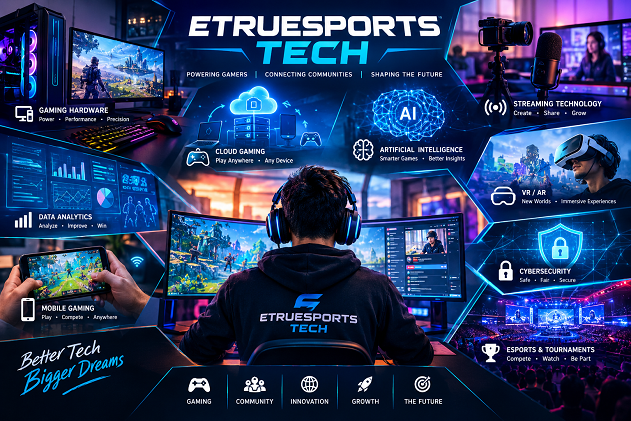

The gaming industry has changed dramatically over the past decade. What was once considered a simple form of entertainment has become a global digital ecosystem involving competitive esports, professional players, live streaming, gaming hardware, artificial intelligence, cloud services, and online communities. At the centre of this transformation is the growing importance of gaming technology, often discussed through the term etruesports tech.
EtrueSports tech can be understood as the combination of technology, gaming, esports, digital platforms, and innovations that improve the way people play, watch, create, and experience games. From high-performance gaming computers to sophisticated esports analytics, technology now influences almost every part of the gaming experience.
Modern gamers expect fast performance, high-quality graphics, reliable internet connections, responsive controls, and immersive experiences. Esports organisations and competitive players require even more advanced systems. They need accurate statistics, communication tools, streaming technology, training software, and reliable tournament infrastructure.
As technology continues to evolve, etruesports tech is becoming an important area for gamers, developers, streamers, esports teams, and technology enthusiasts.
Also read: Gaming Etruesports – Gaming & Esports Complete 2026
What Does EtrueSports Tech Mean?
The phrase etruesports tech represents the technological side of modern esports and gaming. It can include hardware, software, artificial intelligence, gaming networks, streaming platforms, data analytics, virtual reality, augmented reality, cloud gaming, and other digital innovations.
Technology is particularly important in competitive gaming because even a small performance difference can influence the outcome of a match. Low latency, stable frame rates, accurate peripherals, and reliable communication can all contribute to a better competitive environment.
However, etruesports tech is not only about professional competitions. Everyday gamers also benefit from technological improvements. Modern consoles, smartphones, gaming laptops, graphics cards, monitors, headphones, controllers, and internet services continue to make gaming more accessible and enjoyable.
The Role of Gaming Hardware
Gaming hardware is one of the most visible parts of etruesports tech. A powerful gaming setup can significantly improve performance and visual quality.
Gaming PCs often use advanced processors and graphics processing units to render complex game environments. Modern graphics technology allows developers to create realistic lighting, detailed environments, sophisticated character models, and smoother animations.
Gaming monitors are also important. Competitive players often prefer displays with high refresh rates and low response times because these features can make fast-moving gameplay feel more responsive.
Other important hardware includes:
- Mechanical gaming keyboards
- High-precision gaming mice
- Gaming controllers
- Headsets and microphones
- High-refresh-rate monitors
- Gaming laptops
- Graphics cards
- High-performance processors
- Specialised gaming chairs and desks
Together, these technologies create an ecosystem that supports both casual and competitive gaming.
Artificial Intelligence and EtrueSports Tech
Artificial intelligence is becoming increasingly important across the gaming industry. AI can be used for game development, player behaviour analysis, matchmaking, non-player characters, personalisation, security, and automated support systems.
In esports, AI-powered analytics can potentially help teams understand gameplay patterns. Coaches can examine statistics to identify strengths, weaknesses, strategies, and recurring mistakes.
AI can also influence how games are designed. Developers can use machine-learning techniques to create more adaptive experiences, analyse player feedback, and improve game testing.
Another important area is moderation. Online gaming communities can face problems such as cheating, harassment, spam, and inappropriate behaviour. Automated systems can assist platforms in identifying suspicious activity and improving community safety.
As AI technology develops, its role in esports tech is likely to become even more significant.
Cloud Gaming and Online Infrastructure
Cloud technology is another major development in modern gaming. Traditional gaming often requires users to have powerful hardware capable of running demanding games. Cloud gaming changes this model by moving some processing workloads to remote data centres.
Instead of depending entirely on local hardware, users can stream gameplay through an internet connection. This can make certain high-quality gaming experiences accessible on devices that might otherwise struggle to run demanding games.
However, cloud gaming depends heavily on internet quality. Latency, bandwidth, network stability, and server location can affect the experience.
For esports, network infrastructure is particularly important. Competitive games require rapid communication between players and servers. A poor connection can cause lag, delayed inputs, or interruptions.
Therefore, improvements in networking technology are an important part of the wider esports tech ecosystem.
Streaming Technology and Esports
Gaming and esports are closely connected to live streaming. Platforms that allow gamers to broadcast gameplay have created new opportunities for professional players, content creators, commentators, and gaming communities.
Streaming technology includes cameras, microphones, capture cards, broadcasting software, lighting, internet connections, and encoding systems.
A professional streamer may use several technologies simultaneously. Gameplay can be captured from a computer or console, processed through broadcasting software, combined with a webcam feed and microphone audio, and then delivered to viewers through an online platform.
Esports tournaments also depend on streaming technology. Large competitions can reach audiences around the world through live broadcasts.
This means etruesports tech extends beyond gameplay itself. It also supports the production and distribution of gaming content.
Data Analytics in Competitive Gaming
Data has become one of the most valuable resources in esports. Competitive teams can collect information about player performance, match outcomes, strategies, objectives, accuracy, movement, and other gameplay factors.
Analytics can help transform large amounts of raw information into useful insights.
For example, a team could examine:
| Technology Area | Main Purpose | Benefit |
|---|---|---|
| AI | Automated analysis | Identifies patterns and trends |
| Data analytics | Performance measurement | Helps players improve |
| Cloud technology | Remote processing | Flexible gaming access |
| Streaming tools | Live broadcasting | Reaches global audiences |
| Gaming hardware | Performance | Faster and smoother gameplay |
| Network technology | Connectivity | Reduces communication delays |
| VR/AR | Immersion | Creates new gaming experiences |
| Cybersecurity | Protection | Helps secure accounts and systems |
Analytics can also help coaches prepare for opponents. By studying previous matches, teams may identify common strategies and develop counter-strategies.
Virtual Reality and Augmented Reality
Virtual reality and augmented reality represent another exciting part of gaming technology. VR places users inside digitally generated environments, while AR combines digital elements with the physical world.
Although these technologies are not equally popular across all gaming categories, they have considerable potential.
VR headsets can create highly immersive gaming environments. Players can interact with virtual spaces using specialised controllers and motion tracking.
AR can introduce digital game elements into real-world environments. Smartphone-based games have already demonstrated how digital content can interact with physical locations.
Future improvements in displays, sensors, processing power, and tracking technology could make immersive gaming even more advanced.
Mobile Gaming and EtrueSports Tech
Mobile gaming has become a major part of the global gaming industry. Smartphones now contain powerful processors, advanced graphics capabilities, high-refresh-rate displays, and fast connectivity.
This has allowed competitive gaming to expand beyond traditional PCs and consoles.
Mobile esports can support tournaments, professional players, online communities, and streaming. Improvements in mobile processors and network technologies continue to enhance gameplay.
The accessibility of smartphones also means that gaming technology can reach people who may not own dedicated gaming PCs or consoles.
For this reason, mobile gaming should be considered an important component of esports tech.
Cybersecurity and Fair Play
As gaming becomes increasingly connected, cybersecurity has become essential. Players create accounts, make digital purchases, communicate with other users, and store personal information on gaming platforms.
Security technologies can help protect these accounts from unauthorised access.
Competitive gaming also faces the challenge of cheating. Developers and tournament organisers use anti-cheat technologies to detect unauthorised software, suspicious behaviour, and other forms of unfair play.
Maintaining competitive integrity is essential for the long-term growth of esports. Players and audiences need confidence that competitions are being conducted fairly.
The Future of EtrueSports Tech
The future of esports tech is likely to involve greater integration between artificial intelligence, cloud computing, advanced hardware, analytics, immersive technology, and high-speed connectivity.
Gaming devices are becoming more powerful while software is becoming more intelligent. AI may provide more personalised gaming experiences, while cloud technology could make advanced games available across a wider range of devices.
Esports training may also become increasingly data-driven. Players could use detailed performance dashboards to understand reaction time, accuracy, decision-making, positioning, and other aspects of gameplay.
Meanwhile, streaming could become more interactive, allowing audiences to participate in broadcasts in new ways.
Another important trend is accessibility. Technology developers are increasingly exploring ways to make gaming more accessible to people with different physical abilities and preferences.
Why EtrueSports Tech Matters to Gamers
For ordinary gamers, technological development can provide several advantages. Better hardware can improve visual quality and performance. Faster internet can reduce connection problems. Advanced software can improve matchmaking and security.
Technology can also make games more social. Voice communication, live streaming, online communities, and cross-platform features allow players to interact with people around the world.
For professional gamers, the importance is even greater. Their performance can depend on hardware consistency, network reliability, analytics, training tools, and tournament technology.
Therefore, etruesports tech is not simply about buying the newest gaming equipment. It represents a broader ecosystem designed to improve gaming experiences and competitive environments.
How to Choose the Right Gaming Technology
Gamers do not always need the most expensive equipment. The right technology depends on the type of games being played, budget, platform, and personal preferences.
A competitive PC gamer may prioritise a powerful graphics card, fast processor, high-refresh-rate monitor, responsive mouse, and reliable network connection.
A mobile gamer may focus more on battery life, display quality, thermal management, processor performance, and stable connectivity.
Streamers have additional requirements, including a quality microphone, camera, capture equipment, lighting, and sufficient internet upload speed.
The most important principle is balance. Buying a single expensive component while ignoring other parts of the system may not produce the best overall experience.
Benefits and Challenges of Gaming Technology
Etruesports tech provides many benefits, but it also presents challenges.
Major Benefits
- Better gaming performance
- More immersive experiences
- Improved competitive analysis
- Global esports access
- Advanced streaming capabilities
- More sophisticated online communities
- Better security technologies
- New opportunities for professional gamers
- Greater accessibility across devices
Major Challenges
- High hardware costs
- Internet dependency
- Cybersecurity risks
- Cheating and competitive integrity issues
- Rapid technology upgrades
- Privacy concerns surrounding data
- Potential barriers for users with older devices
Understanding both sides helps gamers make smarter decisions about technology.
EtrueSports Tech: A Growing Digital Ecosystem
The most important thing to understand about etruesports tech is that it is not limited to one product or one company. It is an evolving ecosystem that connects gaming hardware, software, esports competitions, online services, streaming, artificial intelligence, data analytics, and digital communities.
Every improvement in one area can influence another. Better processors can support more advanced games. Faster networks can improve cloud gaming. Better streaming tools can expand esports audiences. More sophisticated analytics can improve competitive training.
This interconnected development is what makes gaming technology such an exciting field.
(FAQs): About EtrueSports Tech
What is etruesports tech?
Etruesports tech refers broadly to technologies connected with modern gaming and esports, including hardware, software, AI, analytics, streaming, cloud gaming, networking, cybersecurity, and immersive technologies.
Why is technology important in esports?
Technology provides the infrastructure required for competitive gaming. Players rely on responsive hardware, stable networks, communication systems, analytics, and tournament platforms to compete effectively.
Does etruesports tech include gaming hardware?
Yes. Gaming PCs, graphics cards, processors, monitors, keyboards, mice, controllers, headsets, and other gaming equipment are important parts of the broader gaming technology ecosystem.
How does AI affect esports?
AI can assist with gameplay analytics, player-performance analysis, matchmaking, moderation, game development, security, and other areas. Its applications continue to evolve.
Is cloud gaming part of etruesports tech?
Yes. Cloud gaming uses remote computing infrastructure to deliver games over the internet and is an important area of modern gaming technology.
Why is data analytics useful for esports players?
Analytics can help players and coaches understand performance patterns, identify weaknesses, evaluate strategies, and prepare for future competitions.
Is mobile gaming part of esports?
Yes. Mobile games can support competitive tournaments, professional players, organized competitions, streaming, and large online communities.
What is the future of etruesports tech?
The future is expected to involve greater use of AI, cloud computing, advanced networking, data analytics, immersive technologies, and increasingly powerful gaming hardware.
Can beginners benefit from gaming technology?
Absolutely. Beginners do not need professional-level equipment. Choosing reliable hardware, a stable internet connection, and suitable gaming accessories can significantly improve the overall experience.
Why should gamers follow gaming technology trends?
Following technology trends can help gamers understand new hardware, software, gaming platforms, security developments, and emerging opportunities in esports and digital entertainment.
Conclusion
EtrueSports tech reflects the continuing relationship between technology, gaming, and esports. From powerful gaming hardware and AI-driven analytics to cloud gaming, streaming, cybersecurity, mobile gaming, and immersive technologies, innovation is changing how games are created, played, watched, and experienced.
The future will likely bring even more advanced tools for players, developers, streamers, coaches, and esports organisations. As technology becomes faster, smarter, and more accessible, the gaming ecosystem will continue to expand.
For gamers interested in the future of digital entertainment, understanding esports tech provides a useful perspective on where the industry is heading. Whether someone is a casual mobile gamer, competitive esports player, content creator, or technology enthusiast, gaming innovation will continue to influence the experience.