
The search phrase “ftasiafinance business trends from fintechasia” sits within a much larger story: the rapid transformation of financial services across Asia.
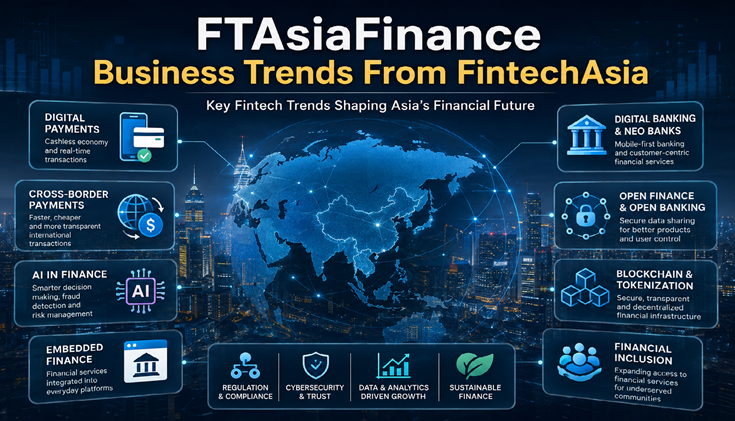
Digital payments, mobile banking, artificial intelligence, embedded finance, open finance, blockchain, and cross-border transactions are reshaping the way businesses move and manage money.
These developments are not limited to Asian markets. American companies with international customers, suppliers, investors, or operations increasingly operate within the same interconnected financial ecosystem.
The scale of that transformation is substantial. The World Bank’s Global Findex Database 2025 found that 79% of adults worldwide had a financial account, compared with 74% in 2021. The report also highlights the growing role of mobile connectivity in expanding access to financial services.
That makes Asian fintech worth watching from a U.S. business perspective.
The real story, however, is not simply about adopting newer technology. The industry is entering a more mature phase, where companies must balance innovation with profitability, security, compliance, and customer trust.
What Does “FTAsiaFinance Business Trends From FintechAsia” Mean?
The phrase is best viewed as a search term describing business and financial technology trends across Asian fintech markets.
It should not be confused with a standardized financial index or independently audited market benchmark.
The broader topic typically covers several areas of fintech, including:
- Digital banking
- Mobile payments and digital wallets
- Artificial intelligence in financial services
- Embedded finance
- Open banking and open finance
- Blockchain and tokenization
- Cross-border payments
- Fintech lending
- Regulatory technology
- Financial inclusion
- Investment and business strategy
That distinction matters when evaluating information online. A fintech article can help explain a trend, but important financial decisions should be based on primary sources, regulatory publications, company filings, and credible market research.
For readers, the goal should be simple: understand what is actually changing, who is adopting it, and whether the change has a meaningful business impact.
The Major FTAsiaFinance Business Trends From FintechAsia
Digital Payments Are Becoming Core Business Infrastructure
Few fintech developments have changed everyday commerce as dramatically as digital payments.
Consumers now expect transactions to be fast, convenient, and nearly frictionless. Businesses have responded by integrating payments directly into websites, apps, marketplaces, and point-of-sale systems.
The shift is bigger than simply replacing cash with smartphones.
Modern payment infrastructure connects banks, fintech companies, merchants, e-commerce platforms, and consumers. As those connections improve, money can move through increasingly sophisticated digital networks.
ASEAN offers a useful example. By late 2025, the region had established multiple bilateral QR payment connections, while QR payment activity had grown significantly during the first half of the year.
For businesses, the potential benefits include:
- Faster checkout
- Lower payment friction
- Greater access to international customers
- Better transaction data
- More opportunities for small merchants
- Easier regional commerce
The next stage is interoperability.
Rather than maintaining completely separate payment experiences in every market, financial institutions are increasingly working to connect existing payment networks.
For international businesses, that could make cross-border commerce considerably easier.
Cross-Border Payments Are Becoming a Strategic Priority
Moving money between countries has traditionally involved multiple layers of complexity.
Different currencies, payment networks, regulatory systems, identity standards, and compliance requirements can slow transactions and increase costs.
Fintech is beginning to address some of those barriers.
The Bank for International Settlements has identified Asia-Pacific as a region at the forefront of payment-system interlinking. It has also highlighted the growing use of APIs and ISO 20022 messaging standards.
The Nexus initiative is another development worth watching. It is designed to connect domestic instant-payment systems through a standardized framework. In 2025, India, Indonesia, Malaysia, the Philippines, Singapore, and Thailand incorporated a legal entity to support its implementation.
The implications extend beyond banks.
A U.S. company selling software, consulting services, digital products, or physical goods to Asian customers could benefit from faster and more transparent payment infrastructure.
There is still a significant caveat: speed cannot come at the expense of compliance.
Companies operating internationally must continue to manage areas such as:
- Anti-money-laundering requirements
- Sanctions screening
- Customer identity verification
- Foreign exchange
- Tax obligations
- Data protection
- Fraud prevention
The technology may make payments faster. The regulatory responsibilities remain.
Artificial Intelligence Is Moving Into the Financial Core
Artificial intelligence has moved well beyond the experimental stage in financial services.
Banks, fintech companies, insurers, and payment providers are using AI and machine learning for a growing range of tasks.
Common applications include:
- Fraud detection
- Customer support
- Credit assessment
- Risk monitoring
- Transaction analysis
- Document processing
- Personalized recommendations
- Compliance monitoring
The business case is compelling. AI can process enormous amounts of information and identify patterns that would take human teams considerably longer to uncover.
But financial institutions face a higher standard than many other industries.
An AI model can influence someone’s credit access, financial security, privacy, or ability to complete a transaction. Errors can therefore have serious consequences.
The International Monetary Fund has highlighted the growing influence of fintech, digital platforms, crypto assets, stablecoins, and artificial intelligence on financial services. It has also emphasized the policy challenges created by these technologies.
For businesses, the better question is not, “Where can we add AI?”
It is:
“Which financial process can AI improve without compromising accuracy, transparency, security, or trust?”
That distinction matters.
An AI system that flags suspicious transactions for human review can improve efficiency. A system that automatically denies customers without adequate oversight can create a very different set of problems.
The technology is powerful. Governance determines whether it creates lasting value.
Embedded Finance Is Changing the Customer Journey
Financial services are increasingly appearing inside products that were never traditionally considered financial platforms.
That is the basic idea behind embedded finance.
A shopper might receive financing during checkout. A freelancer could access an advance through a work platform. A small business might purchase insurance through its accounting software.
The financial service becomes part of an existing workflow rather than a separate destination.
That model can be attractive to both technology companies and financial institutions.
Why Embedded Finance Matters
For digital platforms, embedded financial products can generate:
- Additional revenue
- Higher customer retention
- More frequent engagement
- Better use of transaction data
- New cross-selling opportunities
For banks and financial providers, partnerships with established platforms can also create more efficient routes to customers.
The model does bring additional responsibilities.
Companies need to establish who handles compliance, fraud monitoring, customer support, data protection, and regulatory obligations.
A seamless customer experience should never mean unclear accountability.
Digital Banks Are Moving From Rapid Growth to Sustainable Economics
The first wave of digital banking was heavily focused on customer acquisition.
New entrants competed for users through low fees, promotional offers, attractive rates, and mobile-first experiences.
The market is maturing.
Investors and financial executives increasingly want to know whether digital banks can build durable, profitable businesses.
That requires closer attention to metrics such as:
- Customer acquisition cost
- Customer lifetime value
- Deposit economics
- Credit losses
- Operating expenses
- Revenue per customer
- Retention
- Fraud-related costs
A large customer base does not automatically translate into a strong financial business.
A platform with millions of inactive accounts may be less valuable than a smaller institution with loyal customers and healthy unit economics.
That shift—from growth at almost any cost toward sustainable growth—is one of the most important lessons emerging from the fintech sector.
Open Banking and Open Finance Are Expanding
Open finance takes the concept further by extending data-sharing capabilities across a wider range of financial products.
Asia provides an especially interesting case study because different markets have developed their own regulatory approaches.
The Asian Development Bank’s 2025 APAC State of Open Banking and Open Finance report examined developments across 16 economies. Its findings show that countries are adapting open-finance frameworks to their individual regulatory environments and policy priorities.
The potential benefits are significant.
Potential Benefits
- More competition
- Greater consumer choice
- Easier financial-data aggregation
- More personalized products
- Better access to credit
- Greater consumer control over financial information
But opening financial data also introduces risks.
Potential Risks
- Data misuse
- Cybersecurity threats
- Weak consent systems
- Fraud
- Inconsistent regulation
Trust will be central to the next phase of open finance.
Consumers need to understand where their information goes, who can access it, and how that access can be revoked.
Financial Inclusion Remains a Major Growth Opportunity
Fintech is not only about serving affluent consumers or large corporations.
One of its most significant opportunities lies in reaching individuals and businesses that traditional financial institutions have historically struggled to serve.
The World Bank’s Global Findex 2025 examines financial access, digital payments, savings, borrowing, mobile ownership, and digital connectivity across 141 economies.
Mobile technology is a major part of that story.
Someone living far from a bank branch can potentially access financial services through a mobile device. A small merchant can accept digital payments without building a traditional banking infrastructure.
Digital transaction histories can also help create financial records for people and businesses that previously had limited access to formal credit.
Still, financial inclusion requires more than launching an app.
Products must account for differences in:
- Digital literacy
- Income
- Connectivity
- Device access
- Financial knowledge
- Language
- Consumer protection
A service is not genuinely inclusive if the people who need it most cannot use it reliably.
Regulation Is Becoming Part of Product Strategy
Fintech companies once tended to view regulation primarily as a legal or compliance function.
That approach is becoming increasingly difficult to sustain.
Regulation now affects product design, market entry, partnerships, data architecture, customer onboarding, and operating models.
Cross-border expansion makes the challenge even greater.
A fintech company operating across several countries may face different licensing requirements, consumer-protection rules, reporting standards, and data regulations in each market.
RegTech, or regulatory technology, can help.
Companies use RegTech tools for areas such as:
- Identity verification
- Transaction monitoring
- Compliance reporting
- Risk assessment
- Fraud detection
- Regulatory recordkeeping
Automation can make compliance more efficient, but it cannot eliminate accountability.
Strong fintech businesses increasingly treat compliance as part of product design rather than an issue to address after launch.
Blockchain, Stablecoins and Tokenization Remain Areas to Watch
Blockchain remains an important part of the fintech landscape, although expectations around it have become more measured.
The technology has potential applications beyond cryptocurrencies.
Financial institutions and technology companies continue to explore:
- Tokenization
- Digital assets
- Smart contracts
- Programmable payments
- New settlement systems
The IMF has noted that stablecoins and tokenization could deliver meaningful benefits while also introducing financial-stability and policy risks.
That makes careful evaluation essential.
A business should not adopt blockchain simply because the technology is fashionable.
The better question is whether it solves a specific problem more effectively than existing infrastructure.
For example, blockchain may be useful when several independent parties need a shared, programmable record. A conventional database may remain the better choice for a straightforward internal application.
Good technology strategy starts with the business problem, not the technology label.
FTAsiaFinance Business Trends: Quick Comparison
| Trend | Business Impact | Main Opportunity | Key Risk |
|---|---|---|---|
| Digital payments | Very High | Faster commerce | Fraud |
| Cross-border payments | High | International growth | Compliance |
| AI in finance | Very High | Automation and risk management | Model risk |
| Embedded finance | High | New revenue streams | Regulatory complexity |
| Digital banking | High | Lower-cost financial services | Weak unit economics |
| Open finance | High | Competition and personalization | Data privacy |
| Blockchain | Medium to High | New settlement models | Regulatory uncertainty |
| Financial inclusion | Very High | New customers and markets | Digital exclusion |
Pros and Cons of These Fintech Trends
Pros
- Faster financial transactions
- Better customer experiences
- Lower operational costs
- Greater financial inclusion
- More competition
- New business models
- Improved access to international markets
- More personalized financial services
Cons
- Greater cybersecurity exposure
- More complex regulation
- Data privacy concerns
- AI model risks
- Financial fraud
- Greater dependence on technology
- Uneven digital access
- High implementation costs
The takeaway is not that every business should adopt every emerging technology.
The smarter approach is to identify the trends that solve measurable customer or operational problems.
What These Trends Mean for U.S. Businesses
American companies can take several practical lessons from Asian fintech markets.
Treat Payments as Infrastructure
Payment performance can directly affect conversion, retention, and customer satisfaction.
Businesses should view payment systems as part of the core customer experience.
Build Around Customer Behavior
The most successful financial products often fit naturally into habits customers already have.
Technology works best when it reduces friction rather than asking consumers to learn an entirely new process.
Plan Compliance Early
Regulatory requirements can influence architecture, partnerships, data handling, and market expansion.
Bringing compliance into the planning process is usually more efficient than rebuilding a product later.
Measure Unit Economics
Customer growth tells only part of the story.
Companies should understand acquisition costs, retention, revenue, losses, and the cost of serving each customer.
Use AI Selectively
AI can deliver substantial efficiency gains, but financial applications require careful testing and oversight.
The objective should be measurable improvement rather than AI adoption for its own sake.
Design for Interoperability
Financial services increasingly depend on connections between banks, fintech platforms, payment networks, and other digital systems.
APIs, shared standards, and interoperable infrastructure will become increasingly valuable.
Expert Tips for Following FTAsiaFinance Business Trends
Anyone researching ftasiafinance business trends from fintechasia should look beyond headlines.
Start by identifying the underlying trend. Then ask whether consumers and businesses are actually adopting it.
A useful research process includes six steps:
1. Identify what changed.
Determine whether the development involves technology, regulation, consumer behavior, or business economics.
2. Verify the numbers.
Use primary sources from regulators, central banks, the World Bank, IMF, BIS, and other established institutions.
3. Look for real adoption.
A product announcement does not necessarily indicate meaningful market penetration.
4. Examine the economics.
Ask who pays, who earns revenue, and whether the model can scale profitably.
5. Check regulatory exposure.
A promising fintech model can become much less attractive if licensing or compliance requirements make expansion difficult.
6. Separate innovation from hype.
Technology deserves attention when it solves a real problem and creates measurable value.
That framework is useful for both business executives and investors.
Frequently Asked Questions
What are FTAsiaFinance business trends from FintechAsia?
The phrase generally describes financial technology and business trends associated with Asian markets. Major themes include digital payments, AI, digital banking, embedded finance, open finance, cross-border transactions, and regulation.
Is FTAsiaFinance an official financial index?
There is no widely recognized global financial index known as FTAsiaFinance. The phrase is better understood as a topic or search term associated with fintech and business trends.
What is the biggest fintech trend in Asia?
Digital payments remain among the most visible fintech developments. Cross-border payment connectivity, mobile finance, artificial intelligence, and embedded finance are also significant areas of growth.
How is AI changing fintech?
AI can improve fraud detection, customer service, risk assessment, compliance, and operational efficiency. Financial companies must also address privacy, model risk, cybersecurity, transparency, and governance.
Why are cross-border payments important?
Efficient cross-border payments can reduce transaction friction and support international commerce, remittances, tourism, and regional economic activity.
What is embedded finance?
Embedded finance integrates financial services into non-financial products and platforms. Payments, lending, insurance, and financial accounts can all become part of an existing digital experience.
What is open finance?
Open finance allows customers to share financial information with authorized providers through secure systems. It can encourage competition and support more personalized financial products.
Are Asian fintech trends relevant to U.S. companies?
Yes. U.S. businesses operating internationally can learn from Asian developments in mobile payments, instant-payment networks, digital banking, embedded finance, and financial inclusion.
Is fintech still a strong business opportunity?
Yes, but the market has become more disciplined. Sustainable economics, strong compliance, cybersecurity, reliable infrastructure, and clear customer value are increasingly important.
Should investors treat FTAsiaFinance trend coverage as financial advice?
No. Trend coverage can provide useful background, but it should not replace independent financial research. Investors should verify important claims through primary sources and consider professional advice when appropriate.
Conclusion
The ftasiafinance business trends from fintechasia topic reflects a much broader transformation taking place across Asian financial markets.
Digital payments are becoming more connected. Cross-border payment networks are moving toward greater interoperability. AI is entering core financial operations. Open finance is changing how financial data can move between providers. Embedded finance is bringing banking products into everyday digital experiences.
At the same time, the fintech industry is becoming more pragmatic.
Growth by itself is no longer enough. Companies need sustainable economics, strong cybersecurity, regulatory discipline, dependable technology, and a clear reason for customers to use their products.
For U.S. businesses, Asian fintech markets offer a valuable source of competitive intelligence. The region provides useful examples of how consumers adopt mobile financial services and how payment infrastructure evolves alongside digital commerce.
The larger lesson is straightforward: the future of fintech will not be determined by technology alone. It will depend on how effectively technology solves real financial problems while preserving security, transparency, and trust.
That is the most useful lens through which to understand the business trends surrounding FTAsiaFinance and FintechAsia in 2026.