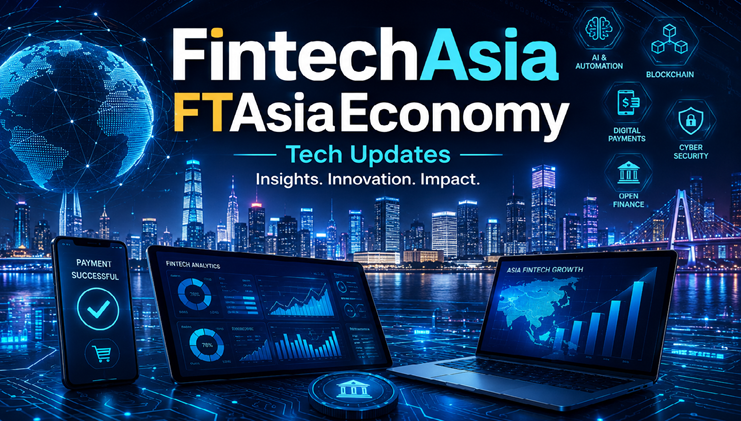

Searches for “fintechasia ftasiaeconomy tech updates” point to a broader interest in Asia’s rapidly changing financial technology and digital economy.
The phrase itself does not describe a single official report, government initiative, or financial product. Instead, it brings together several closely related subjects: FinTechAsia, FTAsiaEconomy, digital finance, emerging technology, and economic developments across Asia.
That broader context is worth understanding.
Asia’s financial sector is undergoing a major shift. Mobile payments are becoming mainstream, banks are experimenting with artificial intelligence, cross-border payment networks are becoming more connected, and financial institutions are exploring tokenization and blockchain-based infrastructure.
For American readers, these developments are more relevant than they may first appear. Asia plays a major role in global commerce, technology, investment, and supply chains. Changes in its financial infrastructure can eventually influence businesses and consumers far beyond the region.
Here’s a closer look at the technology trends behind fintechasia ftasiaeconomy tech updates, what they mean, and what deserves attention in 2026.
What Does FintechAsia FTAsiaEconomy Tech Updates Mean?
FintechAsia FTAsiaEconomy tech updates is best viewed as a search phrase covering fintech and technology developments across Asian markets.
It touches several areas of the digital economy, including:
- Digital banking and mobile finance
- Instant and QR-code payments
- Cross-border transactions
- Artificial intelligence in financial services
- Blockchain and tokenization
- Open finance and APIs
- Digital identity
- Cloud infrastructure
- Cybersecurity
- Fintech investment
- Financial regulation
- Digital economic infrastructure
These technologies rarely operate in isolation.
Consider a modern payment app. It may rely on cloud infrastructure to process transactions, artificial intelligence to identify suspicious activity, APIs to connect with banks, and digital identity technology to verify customers.
That’s why fintech coverage increasingly overlaps with the broader technology sector.
Why Asia’s Fintech Market Deserves Attention
Asia has become one of the world’s most important testing grounds for financial technology.
The reasons are straightforward. The region has enormous consumer markets, widespread smartphone adoption, rapidly expanding digital commerce, and strong demand for convenient financial services.
But Asia isn’t one uniform market.
Singapore serves as a major international financial center. India has built one of the world’s most extensive digital-payment ecosystems. Indonesia has a huge mobile-first consumer market, while Thailand, Malaysia, and the Philippines are developing increasingly connected digital-payment systems.
That diversity makes the region particularly interesting.
Different countries are approaching fintech from different starting points, yet many are moving toward the same broad goal: faster, more accessible, and more connected financial services.
For businesses, that creates new opportunities. For consumers, it can mean simpler transactions. Regulators, meanwhile, face the difficult task of encouraging innovation without compromising financial stability or consumer protection.
The Biggest FintechAsia FTAsiaEconomy Tech Updates to Watch in 2026
1. Digital Payments Are Moving Further Into the Mainstream
Digital payments remain one of the clearest fintech stories across Asia.
Consumers increasingly rely on mobile wallets, QR codes, banking apps, contactless cards, and instant-payment platforms for everyday purchases and transfers.
The change is about more than convenience.
Digital transactions can help small businesses accept payments online, create clearer transaction records, and participate in expanding e-commerce markets. They can also reduce some of the friction associated with cash-based transactions.
Research from the International Monetary Fund has highlighted significant progress in domestic and cross-border digital payments across ASEAN.
The next challenge is making those systems work together.
A payment network becomes far more useful when consumers can make transactions across borders without navigating a completely different system in every country.
2. Cross-Border Payments Are Becoming a Strategic Priority
Sending money across borders has traditionally involved multiple banks, intermediaries, currency conversions, compliance checks, and settlement processes.
Technology is beginning to change that model.
Asia accounted for roughly 32% of global cross-border payments in 2024, according to IMF research. The region’s share could reach approximately 37% by 2032, with overall cross-border payment volume expected to grow substantially.
That growth has attracted attention from central banks and international financial institutions.
The Bank for International Settlements, for example, has developed Project Nexus, an initiative designed to connect domestic instant-payment systems through a common framework.
India, Indonesia, Malaysia, the Philippines, Singapore, and Thailand have been involved in efforts to move the project toward live implementation.
For businesses operating internationally, better payment connectivity could lower friction and make regional commerce easier.
For consumers, the long-term benefit could be simpler and faster international transfers.
3. Artificial Intelligence Is Changing Financial Services
Artificial intelligence has moved beyond the experimental stage at many financial institutions.
Banks, fintech companies, insurers, and other financial businesses are already exploring AI for practical tasks such as:
- Fraud detection
- Credit assessment
- Customer support
- Risk analysis
- Compliance monitoring
- Document processing
- Data analysis
- Back-office automation
Generative AI adds another dimension.
Financial institutions can use large language models to summarize documents, assist employees, analyze information, draft communications, and support internal research.
The technology, however, comes with serious questions.
Financial companies must account for inaccurate AI outputs, privacy concerns, cybersecurity threats, model risk, and dependence on outside technology providers.
That makes governance just as important as adoption.
The strongest financial AI strategies are unlikely to be the ones that simply deploy the most models. They will be the ones that identify clear business problems and apply AI where it can produce measurable value while maintaining appropriate controls.
4. Blockchain Is Shifting Toward Practical Financial Applications
Blockchain continues to appear in fintech discussions, but the focus has changed.
The conversation is increasingly moving beyond cryptocurrency speculation toward tokenization, digital securities, settlement, trade finance, and tokenized deposits.
The Bank for International Settlements has identified potential applications for tokenization in areas such as trading, settlement, and collateral management.
Asian markets are also experimenting with practical blockchain applications.
Research from the Asian Development Bank has highlighted initiatives involving areas such as trade finance in Thailand and Vietnam, land leasing in Fiji, and carbon trading in China.
These examples point to an important shift.
The most valuable blockchain applications may not necessarily involve speculative assets. Instead, they may emerge where distributed records, transparency, and programmable transactions can solve a specific operational problem.
That is a much more practical proposition for banks and businesses.
5. Open Finance Could Make Financial Services More Connected
Another development worth watching is open finance.
At its core, open finance allows financial institutions and technology companies to connect services and data through APIs, subject to appropriate permissions and security controls.
That can support services such as:
- Account aggregation
- Payment integration
- Financial analytics
- Faster customer onboarding
- Embedded financial products
- Small-business financial services
- Automated reporting
The BIS has explored cross-border open-finance interoperability through initiatives such as Project Aperta.
The appeal is obvious. Instead of forcing every financial service to operate inside a closed ecosystem, APIs can help different systems communicate.
But greater connectivity also raises the stakes for privacy and security.
Consumers need meaningful control over their financial information, while companies must protect sensitive data against unauthorized access and misuse.
6. Cybersecurity Is Now Central to Fintech Strategy
Every new digital financial service creates potential vulnerabilities.
That’s why cybersecurity has become one of the most important parts of fintech development.
A financial platform may need to defend against account takeovers, payment fraud, phishing, data theft, malicious software, and attacks on third-party providers.
The challenge becomes even more complex as banks and fintech companies depend on cloud infrastructure and interconnected digital services.
The Asian Development Bank has identified cybersecurity, privacy, data governance, digital skills, and responsible AI as important areas for the region’s digital development.
The lesson for fintech companies is clear: security cannot be added after a product launches.
It needs to be part of the architecture from the start.
Fintech Is Becoming Part of Asia’s Broader Digital Economy
Financial technology doesn’t exist in a separate bubble.
It supports e-commerce, logistics, manufacturing, international trade, government services, healthcare, education, and countless other industries.
The Asian Development Bank’s research on economic integration has highlighted the role of digital growth and AI in supporting investment and deeper regional connections.
Consider a small online retailer.
It may use a digital payment platform to accept customer orders, cloud software to manage its inventory, an AI system to forecast demand, and a digital bank to manage cash flow.
None of those technologies is remarkable on its own.
Together, however, they create a very different business environment from the one that existed a decade ago.
That’s the larger story behind many of the fintechasia ftasiaeconomy tech updates appearing today.
FintechAsia FTAsiaEconomy Tech Updates: Key Trends Compared
| Technology | Primary use | Potential benefit | Key challenge |
|---|---|---|---|
| Digital payments | Everyday transactions | Speed and convenience | Fraud and privacy |
| Cross-border payments | International transfers | Lower transaction friction | Regulation and interoperability |
| Artificial intelligence | Analysis and automation | Efficiency and better decision-making | Model risk |
| Blockchain | Settlement and records | Transparency and programmability | Governance and scalability |
| Open finance | Data and service integration | Greater connectivity | Data security |
| Cloud computing | Financial infrastructure | Scalability | Operational resilience |
| Digital identity | Customer verification | Faster onboarding | Privacy |
| Cybersecurity | System protection | Greater trust | Constantly evolving threats |
What These Developments Mean for U.S. Readers
Why should an American reader care about fintech developments in Asia?
Because financial technology rarely stays within national borders.
Asian economies are deeply connected to global trade, technology, manufacturing, e-commerce, and investment. American companies doing business in the region may eventually interact with the payment systems, digital platforms, and financial infrastructure being developed there.
There is another reason to pay attention.
Some Asian markets have moved quickly in areas such as mobile payments and digital financial services. Their experience can offer useful clues about technologies that could become more common elsewhere.
For U.S. businesses, the developments may influence international payment strategies and partnerships.
For consumers, they provide an early look at how financial services could become faster, more integrated, and increasingly automated.
Pros and Cons of Asia’s Rapid Fintech Growth
Pros
- Faster and more convenient payments
- Greater access to financial services
- Improved support for digital commerce
- New opportunities for startups
- More efficient cross-border transactions
- Better access to financial data
- Potential productivity gains from AI
- More digital tools for small businesses
Cons
- Greater exposure to cyberattacks
- Privacy and data-protection concerns
- Complex regulatory requirements
- AI-related errors and model risks
- Unequal access to digital services
- Dependence on technology providers
- Operational and financial stability risks
- Difficulties coordinating regulations across borders
The opportunity is significant, but rapid adoption creates responsibilities that cannot be ignored.
Expert Tips for Following FintechAsia FTAsiaEconomy Tech Updates
Look Beyond Product Announcements
A new app or AI feature can generate attention, but adoption matters more.
Look for evidence such as transaction volumes, active users, merchant adoption, revenue growth, or actual deployment.
Pay Attention to Regulators
Central banks and financial regulators can shape fintech markets as much as technology companies do.
A new rule can change how a payment service, digital bank, or AI system operates.
Separate Pilots From Real-World Adoption
A successful technology demonstration does not necessarily mean consumers will use the product at scale.
When reading about blockchain, AI, or digital-payment projects, check whether the technology has moved beyond testing.
Watch Interoperability
Some of the most important fintech developments may involve connecting existing systems rather than replacing them.
Payment networks, APIs, digital identity, and open-finance infrastructure are therefore worth watching closely.
Treat Security as a Core Metric
A financial service cannot be judged by speed and convenience alone.
Reliability, privacy, fraud protection, and operational resilience matter just as much.
How to Evaluate a Fintech Technology Update
Before accepting a major fintech claim, ask five simple questions:
- Who published the information?
- What evidence supports the claim?
- Has the technology been deployed at scale?
- Which regulations apply?
- What risks or limitations remain?
This approach helps separate meaningful developments from promotional announcements.
It also produces better technology reporting.
Frequently Asked Questions
What are FintechAsia FTAsiaEconomy tech updates?
FintechAsia FTAsiaEconomy tech updates is a search phrase associated with fintech, financial technology, economic developments, and emerging technology trends across Asia. It should not be treated as the name of one official report or organization.
What are the biggest fintech trends in Asia in 2026?
Digital payments, cross-border payment connectivity, artificial intelligence, open finance, blockchain, tokenization, cybersecurity, and digital infrastructure are among the major trends shaping Asian financial technology.
Why are digital payments growing across Asia?
Mobile-first consumers, expanding e-commerce, smartphone adoption, and government-backed payment infrastructure have helped accelerate digital payments. Cross-border interoperability is now becoming an important next step.
How is artificial intelligence changing fintech?
AI can help financial companies detect fraud, assess credit risk, analyze data, automate routine work, support customers, and monitor compliance. Generative AI is expanding the number of potential applications.
Is blockchain still relevant to financial technology?
Yes. Its role is increasingly focused on practical applications such as tokenization, trade finance, settlement, and shared digital records rather than cryptocurrency speculation alone.
What is cross-border payment interoperability?
Cross-border payment interoperability allows different national or regional payment systems to connect. The goal is to make international transactions faster, simpler, and more efficient.
What are the biggest risks associated with fintech growth?
Cybersecurity threats, fraud, privacy issues, AI model failures, regulatory uncertainty, operational dependencies, and financial stability concerns remain major risks.
Why should American businesses watch Asian fintech developments?
Asia is a major center for digital commerce, technology, manufacturing, and financial innovation. New payment systems and financial infrastructure can affect companies involved in international trade and investment.
What fintech developments should readers watch next?
Watch AI adoption, instant-payment connectivity, fintech regulation, tokenization, open finance, digital identity, cybersecurity, and the expansion of digital infrastructure.
Where can readers verify fintech and financial technology information?
Primary sources should come first. Central banks, financial regulators, the International Monetary Fund, the Bank for International Settlements, the Asian Development Bank, and official company disclosures can provide stronger evidence than unsourced social-media claims or promotional content.
Conclusion
The story behind fintechasia ftasiaeconomy tech updates is ultimately a story about how technology is changing the way money moves, businesses operate, and economies connect.
Across Asia, digital payments are becoming more sophisticated. Cross-border payment networks are moving toward greater interoperability. Banks are experimenting with AI, while blockchain and tokenization are finding more practical financial applications. At the same time, cybersecurity and data governance are becoming essential parts of the conversation.